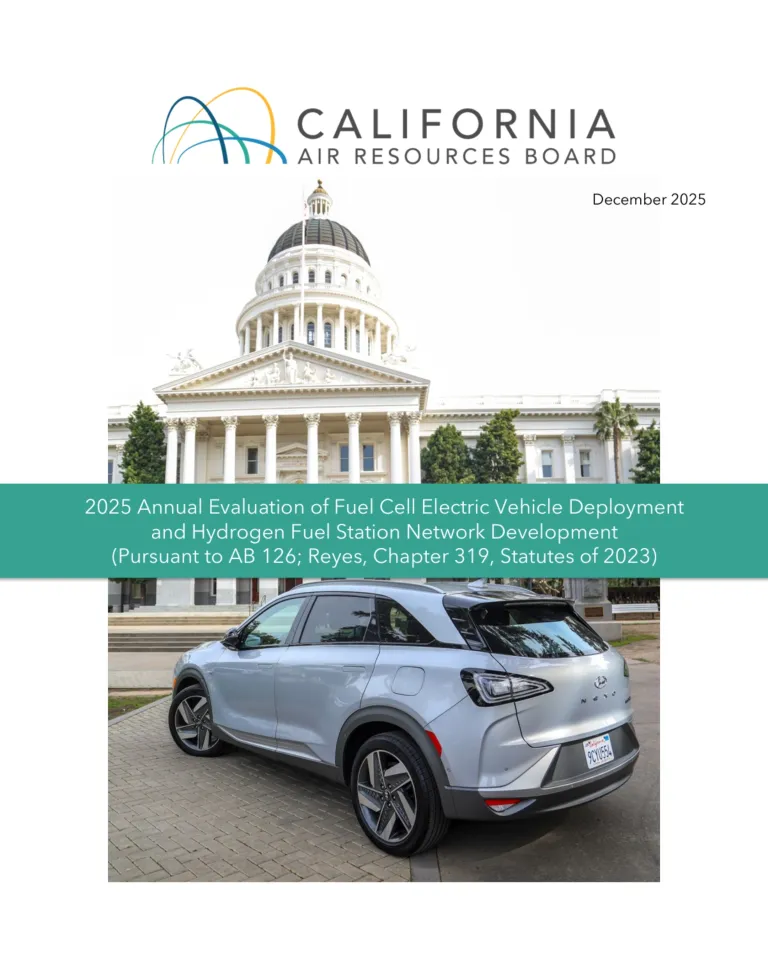
The California Air Resources Board (CARB) released its 2025 Annual Evaluation of Fuel Cell Electric Vehicle Deployment and Hydrogen Fuel Station Network Development this month, providing the most current assessment of California's hydrogen transportation sector.
The report, mandated by Assembly Bill 126, offers important data for station developers, fleet operators, policymakers, and hydrogen advocates. Highlights include:
Current Infrastructure Status
As of August 29, 2025, California operates 61 hydrogen fueling stations, with 50 available for retail operations. Chevron recently entered the market with new stations in Vacaville and Moreno Valley, adding 1,616 kg/day of fueling capacity. The report projects the network will reach 112 stations by 2031, down from previous projections of 129, reflecting adjustments based on current development timelines and station operator feedback.
Vehicle Fleet & Technology
California's registered FCEV population stands at 14,128 vehicles as of April 2025, marking the first recorded year-over-year decline in registrations. Auto manufacturers' 2028 projections show 16,210 FCEVs on the road, reflecting lower near-term sales forecasts than previously anticipated. However, the report highlights significant technology advancements: Toyota's third-generation fuel cell system offers a 20% increase in cruising range, and Hyundai's second-generation Nexo targets approximately 435 miles of range.
Infrastructure Reliability & Coverage
Station operators have made measurable progress in improving equipment reliability and repair times, with average network availability improving from 58% in Q2 2024 to 74% in Q2 2025. Coverage remains strong in disadvantaged communities, with 93% of known station locations within a 15-minute drive of disadvantaged communities and serving 71% of California's DAC population.
The report identifies regional coverage gaps in the Sacramento, San Francisco, Greater Los Angeles, and San Diego areas, with growth potential in emerging markets such as Davis, Elk Grove, Roseville, Santa Rosa, and Livermore.
What's Next
CARB recommends sustained investment in station reliability, engagement with developers on barriers to build-out, integration of medium-duty vehicle fueling capabilities, and coordination between hydrogen production efforts and fueling infrastructure development.