The past two months have been a reminder of something the U.S. energy system has always known but periodically has to relearn: oil is a global commodity, and when anything disrupts it anywhere, Americans pay for it everywhere.
The U.S. imports roughly 6.6 million barrels of crude oil daily from Canada, Mexico, Saudi Arabia, Iraq, Brazil, and dozens of other countries. The EIA's standing estimate is that every $1-per-barrel change in global crude prices moves U.S. pump prices by about 2.4 cents per gallon. Multiply that by a major supply shock, and the transmission from a distant shipping lane to a gas station near you takes weeks, not years.
Hydrogen: Fuel that can be made in the U.S.
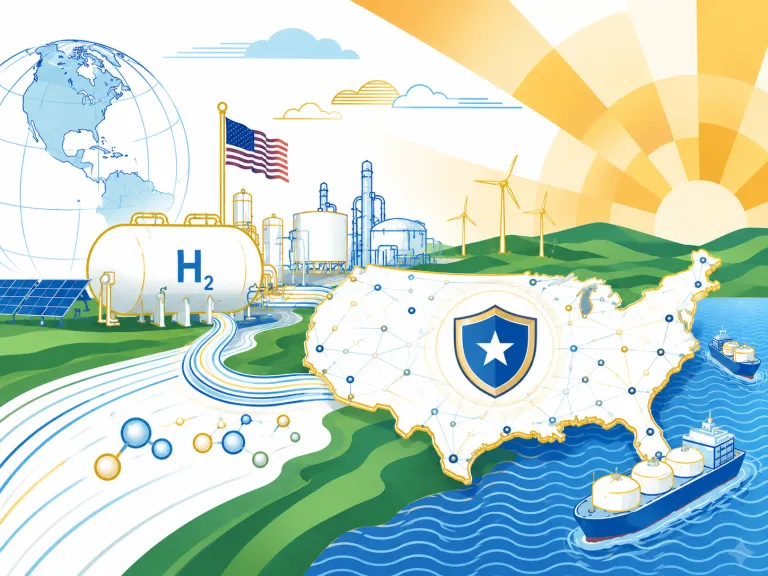
The starting point for the energy security argument is simple: hydrogen can be produced domestically, from multiple feedstocks, without requiring a barrel of imported crude.
A 2023 DOE National Clean Hydrogen Strategy and Roadmap documented the full range of domestic production pathways: natural gas reforming using abundant U.S. supply; woody and waste biomass converted to biomethane and reformed to hydrogen; and electrolysis powered by domestic solar and wind. Each of these pathways can be built and operated within U.S. borders. None of them requires purchasing fuel on the global oil market.
The U.S. already produces approximately 10 million metric tons of hydrogen annually (roughly 10 percent of global supply). The task is shifting production from fossil-based to renewable-based and scaling it to meet demand across sectors that today run entirely on oil and gas.
California Is Already Demonstrating This
California's fuel cell electric vehicle network runs on domestically produced hydrogen. Under California's Low Carbon Fuel Standard, stations are required to dispense at least 40 percent renewable hydrogen: a regulatory floor, not an aspiration, built into how the network operates today. The infrastructure is real, the fuel is domestic, and the supply chain doesn't move with global crude prices.
On the power generation side, LADWP's Intermountain Power Project, an 840-megawatt combined-cycle plant that began commercial operation in July 2025, is designed to run on a blend of up to 30 percent green hydrogen at start-up. It is engineered to reach 100 percent hydrogen by 2045, displacing fossil-fuel generation for millions of Californians using domestically produced fuel.
The California Energy Commission has identified hydrogen as a long-duration energy storage resource capable of firming the grid when solar and wind output drops, contributing directly to the reliability targets embedded in SB 100, California's mandate to reach 100 percent clean electricity by 2045.
What unlocking hydrogen's full potential requires is scale. Scale requires financing. And financing requires long-term offtake commitments that give lenders enough certainty to fund large renewable production projects. That's the work ahead for the industry, policymakers, and members who are investing in this supply chain now.
"Energy independence doesn't happen passively," said Bill Elrick, Executive Director of H2FCP. "It requires fueling stations, domestic supply chains, and production infrastructure built to support hydrogen as a real alternative to imported oil. Every station that opens, every fuel cell truck deployed, and every kilogram of renewable hydrogen produced here is a step in that direction."
NOTE: As of late April, many of TrueZero’s hydrogen fueling stations have begun receiving liquid hydrogen deliveries and are currently operational or will be in the very near future. Drivers are encouraged to keep checking SOSS for real-time status updates.