Hydrogen fuel cell trucks already do the job. They match diesel on range, payload, and refueling speed across the duty cycles that move California's freight.
H2FCP's recently launched white paper, Guiding Principles for Hydrogen Truck Market Development, shows that the path to scale is clear and runs through economics that hold up thanks to bipartisan support.
The confidence is earned. The paper employs structured modeling using a cross-sector panel that included Toyota, Hyundai, Air Liquide, Chevron, Shell, the California Air Resources Board (CARB), and the Governor’s Office of Business and Economic Development (GO-Biz).
When federal and state ZEV policy shifted in 2025, the modeling held. It confirmed the core insight: the technology was never the obstacle.
Fuel cell electric trucks (FCETs) are operationally viable today, and the work of building durable market conditions is already underway. Start with the cost of dispensed hydrogen, the strongest lever in the system. Fleets report that hydrogen competes with diesel in the $5–$12/kg range, and transit agencies have already sustained prices near $10/kg under long-term offtake contracts.
-
SHARE with your network by using our public toolkit (social media captions, graphics, and more!)
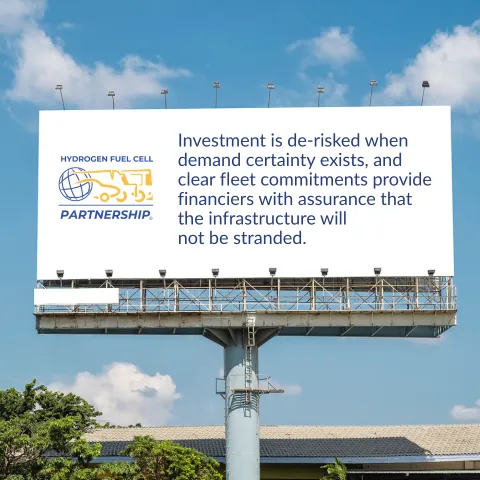
The route there is demand aggregation: anchor fleets and regional consortia signing offtake agreements that give developers the certainty to finance stations. It's happening now. Hyundai's Georgia project and Toyota's Ontario facility show fleet- and OEM-led investment building hydrogen infrastructure without heavy public subsidies. Market certainty is the missing piece, and these projects prove it.
The white paper lays out a dual-track strategy that any stakeholder can act on. Track one leverages states that retain strong mandates and stacks incentives like Clean Truck and Bus Voucher Incentive Project (HVIP) vouchers, Low Carbon Fuel Standard (LCFS) credits, and state and local grants. Track two stands on economics alone, anchored by low-cost fuel supply, fleet collaboration, and reliable multi-modal stations along freight corridors and nodal hubs.
“We have a clear, achievable path to a hydrogen truck market that lasts. It's built on fleet economics, infrastructure that performs, and partnerships already delivering results,” said H2FCP Executive Director Bill Elrick.
Durable hydrogen infrastructure is the foundation of zero-emission freight. These Guiding Principles illuminate the pieces to build it.
Join the movement to fuel the hydrogen future at h2fcp.org/join-us.
Resources
A cross-sector panel of industry experts applied structured cause-and-effect modeling to identify the critical barriers to hydrogen adoption in medium-…