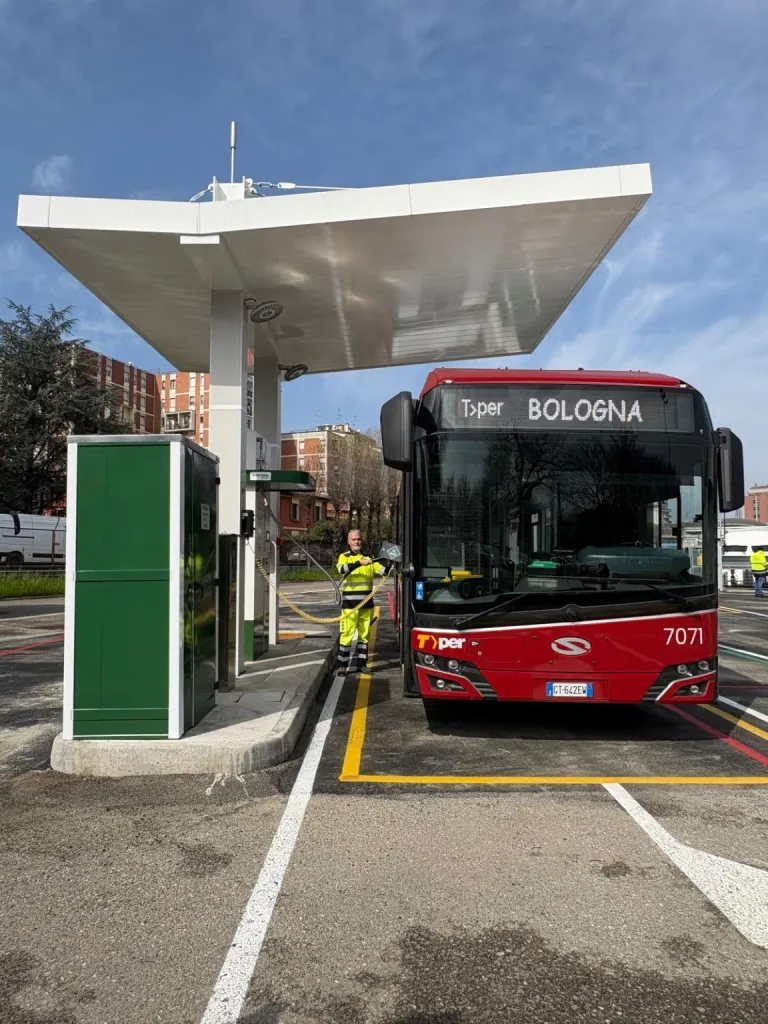
This past spring, Wolftank Group (H2FCP Associate Member) completed a hydrogen refueling station at the Battindarno depot of Trasporto Passeggeri Emilia-Romagna (TPER), the second hydrogen station in Bologna, and a working piece of what will become Italy's largest hydrogen bus fleet.
Wolftank Group develops and implements technologies around the world to decarbonize transport and build the infrastructure for zero-emission mobility
TPER, the public transport operator for the Emilia-Romagna region, plans to run 127 hydrogen buses. Total investment in the Bologna refueling infrastructure amounts to about €6 million.
TPER already runs the same fuel cell bus model in Ferrara. Ten hydrogen buses entered service there after the city's first hydrogen station came online in September 2025. Over five months, they covered more than 62,000 kilometers in passenger service, averaging 14 to 15 kilometers per kilogram of hydrogen.
The Bologna fleet builds on a system that's already carrying passengers.
The Battindarno station is a turnkey build. Hydrogen arrives by trailer, gets compressed through two parallel compressors inside a Wolftank Group H2 Logistic Container, and feeds two dispensers that fuel the buses at 350 bar. A control system tracks tank temperature and pressure in real time.
Wolftank Group delivered the project on schedule and in accordance with European Commission and Italian government rules for PNRR funds. The contract for this station was worth roughly €4.9 million. TPER has worked with Wolftank Group as its hydrogen fueling partner since early 2023, with earlier contracts of €9.5 million in June 2023 and €15.5 million in May 2024 covering stations in Bologna and Ferrara.
Bologna's hydrogen network keeps growing. Two more refueling stations are planned for the program: one is currently under construction, and the other is in the design phase.
Here's why this matters beyond Italy. Fleet operators across multiple continents are reaching the same conclusion: hydrogen works for heavy-duty transit when the fueling infrastructure is designed to match the fleet. Buses run long daily routes, return to a central depot, and refuel fast. That operating profile fits hydrogen well, and Bologna is proving it at fleet scale. A multi-station program signals years of planned service, well past the pilot stage.
“Bologna shows what fleet-scale hydrogen looks like when an operator commits, and the fueling follows,” said Bill Elrick, Executive Director, Hydrogen Fuel Cell Partnership. “Transit agencies here are on the same path, and every station that comes online makes the next one easier to build.”