There's a perception that fuel cell technology is static while other clean energy technologies race ahead. That perception is wrong.
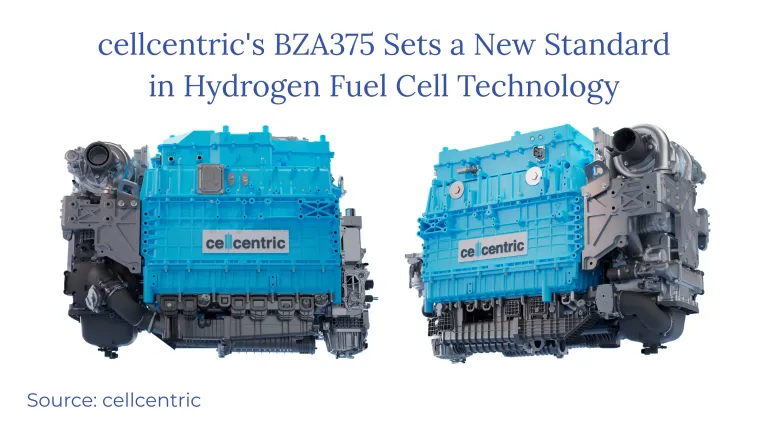
The Hydrogen Fuel Cell Partnership’s Board Member cellcentric, the fuel cell joint venture between Daimler Truck and the Volvo Group, recently unveiled the BZA375 at Hannover Messe, designed specifically for heavy-duty use cases.
The specs: 375 kW of power output (20% improvement in fuel consumption), a 40% improvement in power density over the current-generation BZA150, and a 25,000-hour service life. That's 10 years of heavy-duty service, on par with modern diesel engines. The system was developed in under three years and is now in prototype production at cellcentric's Esslingen, Germany, facility, and is available to OEM customers today for testing and validation across a broad range of applications.
The BZA375 also marks a design shift. While the current BZA150 uses a twin-system configuration to cater to the power needs of, for example, a Class 8 truck, the new system is a single package that fits into conventional 13-liter diesel engine compartments, reducing integration complexity for truck manufacturers and lowering the barrier for fleets looking to switch.
H2FCP members and industry companies have been on a similar trajectory:
- Toyota's third-generation FC system is engineered to match diesel's durability in commercial vehicles and targets market introduction in North America and other major markets.
- Honda's next-generation module, the first developed independently without GM, is scheduled for mass production in 2027 with half the production cost and triple the volumetric power density of the current system.
- Ballard's ninth-generation FCmove-XD holds the industry's highest volumetric power density for heavy-duty applications.
And at the outer edge of the application range, AVL and Red Bull Advanced Technologies are targeting a PEM fuel cell stack power density of 6 kW/kg, potentially the highest gravimetric power density fuel cell system in the world, for aviation and motorsport. AVL has been building propulsion systems for nearly 80 years. Companies with that kind of engineering history don't publish specific performance targets unless they have a clear line of sight to getting there.
That's the story the hydrogen industry doesn't tell often enough. The technology keeps advancing. The commitments keep getting more specific. The timelines keep getting shorter.
H2FCP members are driving hydrogen technology forward. Join the movement today: h2fcp.org/join.