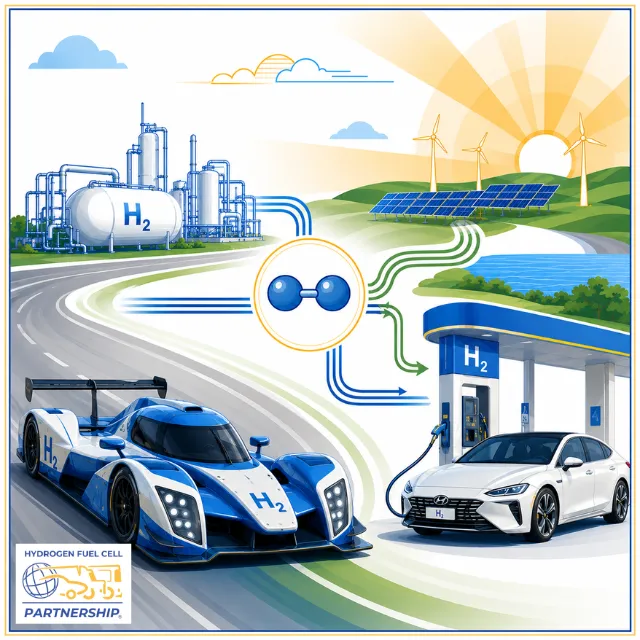
For more than a century, hydrogen has powered industries behind the scenes. Today, that same proven technology is moving out of refineries and chemical plants and onto our roads, rails, and into our power systems. The transition isn't theoretical. It's already underway.
Motorsports have always shown us what’s coming. 2025 was a watershed year for hydrogen in racing. Honda ran a fuel cell car at Pikes Peak for the first time in the event's history. Toyota's hydrogen Corolla completed the Fuji 24 endurance race. The Federation Internationale de l'Automobile (FIA) launched Extreme H, the world's first hydrogen motorsports championship. The Automobile Club de l'Ouest (ACO) confirmed hydrogen cars on the Le Mans grid in 2028.
And Toyota Racing will conduct the first public demonstration drives of its liquid hydrogen-fuelled TR LH2 Racing Prototype at the Circuit de la Sarthe, venue for the 94th edition of the Le Mans 24 Hours, in June 2026.
Performance lessons learned at the edge of the sport have a way of showing up in the vehicles people drive to (and for) work.
On America’s roads, that's already happening. Over 19,000 hydrogen vehicles have been sold or leased since 2015, with the majority in California. Toyota's third-generation fuel cell system, announced in early 2025, delivers twice the durability and 20 percent greater range than its predecessor, with cost reductions built into the manufacturing process. Each generation has brought higher power density, longer stack life, and better efficiency.
For transit agencies, performance means running high-utilization routes across multiple shifts. Hydrogen buses refuel in roughly 20 minutes, keeping vehicles on the road with minimal downtime. A station that fills multiple buses an hour, operated by a driver with a standard commercial license, is what good performance looks like to a fleet manager.
Two fuel cell systems in AC Transit's hydrogen bus fleet exceeded the federal 25,000-hour durability target in independent testing conducted by the National Renewable Energy Laboratory (NREL). For large transit fleets, hydrogen refueling infrastructure costs significantly less to build than equivalent charging capacity at scale (example and example).
In freight, the numbers are equally concrete. Toyota-Kenworth T680 fuel cell trucks deployed through the ZANZEFF Shore to Store project at the Port of Los Angeles ran fully loaded at 82,000 lbs, refueled in 15 to 20 minutes, and covered 400 to 500 miles per day. Hyundai's XCIENT fleet has logged more than 20 million kilometers across Europe, and also has 63 trucks operating in North America.
What’s more, Toyota recently joined Daimler Truck and the Volvo Group’s (cellcentric) effort to accelerate the development of hydrogen fuel cell technology for heavy-duty trucks. They plan to share technological developments and address common challenges to achieve sustainable, effective implementation of fuel cell systems for heavy-duty applications.
For heavy-duty Class 8 operations, hydrogen offers a 500-plus-mile range with fill times comparable to diesel, making it a genuine one-to-one replacement in the most demanding freight applications.
Rail is adding its own proof points. San Bernardino County Transportation Authority's ZEMU, built by Stadler, recently became the first hydrogen-powered, zero-emission passenger train to enter regular service in the United States, running the nine-mile Arrow Corridor of Metrolink's San Bernardino Line and meeting Federal Railroad Administration requirements, with water vapor as its only emission.
Aviation is logging early results too. In 2024, Joby Aviation and its subsidiary H2FLY flew a hydrogen-electric demonstrator 523 miles with water as the only byproduct, landing with 10 percent of its liquid hydrogen load remaining in what Joby believes was the first forward flight of a vertical-takeoff aircraft powered by liquid hydrogen.
“H2FCP is proud to represent the automakers, fuel suppliers, transit agencies, and infrastructure operators who are actually doing this work every day,” said Bill Elrick, Executive Director of H2FCP. “When we say hydrogen performs, we're not speaking theoretically. We're speaking from the people who show up every morning to fuel vehicles, run routes, and move freight and people across our nation’s most demanding corridors.”
The safety record behind all of this reflects more than two decades of rigorous standards work. SAE International, the National Fire Protection Association, the American National Standards Institute, the International Organization for Standardization, CSA Group, and the Compressed Gas Association are among the organizations whose documents govern every aspect of hydrogen storage, pressurization, and dispensing. Federal Motor Vehicle Safety Standards specify performance requirements for hydrogen fuel systems under both normal operation and crash conditions. See safety, codes, and standards resources on H2Tools.
Hydrogen is building on more than a century of industrial hydrogen experience, and every mile logged, every bus route completed, every drayage run finished is one more proof point.
GO DEEPER: Explore H2FCP's heavy-duty fuel cell truck resources and track California's hydrogen fueling network in real time at SOSS.
Learn more about membership at h2fcp.org/join-us.