By Bill Elrick, Executive Director of the Hydrogen Fuel Cell Partnership
An article ran recently describing the state of hydrogen in California:
- Fewer retail stations than a few years ago.
- Fuel supply disruptions and paused projects.
- The loss of federal hub funding
Those conditions are real, and H2FCP tracks them more closely than anyone.
Our Station Operational Status System (SOSS) reports station status publicly and in real time every day. We built it, and we keep it open because a market that hides its performance problems never fixes them.
Where we parted ways with the article is in its conclusions.
Every fuel transition in American history involved a period when vehicles, fuel, and infrastructure were out of step with one another. It's a sequencing problem with known solutions, and H2FCP has spent more than two decades documenting them. Hydrogen's biggest challenge isn't proving it works; it's scaling to meet demand and realize its potential.
Fuel supply redundancy is the first fix
In February 2026, a compressed hydrogen trailer incident in Colton took a large share of California's transportation hydrogen supply offline. Stations that depended on it couldn't fuel; drivers were rerouted, and fleet operators idled.
Too much of California's transportation hydrogen moves through too few production and distribution points, so a failure at a single link can take down a large share of the network.
We believe the answer is more production sites closer to demand, with more delivery pathways serving them, and that work is already underway. Distributed production facilities are coming online and serving fleets today, and each new one adds redundancy the network didn't have eighteen months ago.
ARCHES lost its federal cost share
In October 2025, the U.S. Department of Energy (DOE) terminated the award to the Alliance for Renewable Clean Hydrogen Energy Systems (ARCHES), as reported by Environment+Energy Leader. About $30 million of the $1.2 billion had been disbursed. ARCHES appealed. A coalition of states filed a lawsuit, and the case is still pending.
Federal money left project budgets, timelines slipped, and stakeholders must revisit projects amid uncertain, shifting conditions.
The opportunity for what that money was going to build hasn't changed: ARCHES organized more than 400 partners around a $12.6 billion program, projecting over 220,000 jobs and $2.95 billion in annual economic value starting in 2030, most of it health savings from cleaner air in the Los Angeles Basin, the Bay Area, the Central Valley, and the Inland Empire.
Those numbers rest on freight demand and community air quality needs that exist whether or not Washington cost-shares them. The projects best positioned to advance now are the ones with committed offtake.
Heavy-duty is where the fuel case is strong
Class 8 trucks make up about two percent of vehicles on California roads, yet they account for over nine percent of the state's greenhouse gas emissions and 32 percent of its nitrogen oxides.
That's the emissions math behind our vision of 70,000 fuel cell electric trucks supported by 200 heavy-duty stations by 2035. Drayage and long-haul duty cycles run tight turnarounds with heavy payloads, and fast fueling and energy density matter most in exactly those applications.
Both zero-emission tracks are necessary because of the scale of the task. Battery electric and hydrogen fuel cell vehicles address different parts of the same problem, and the freight sector needs both to be solved.
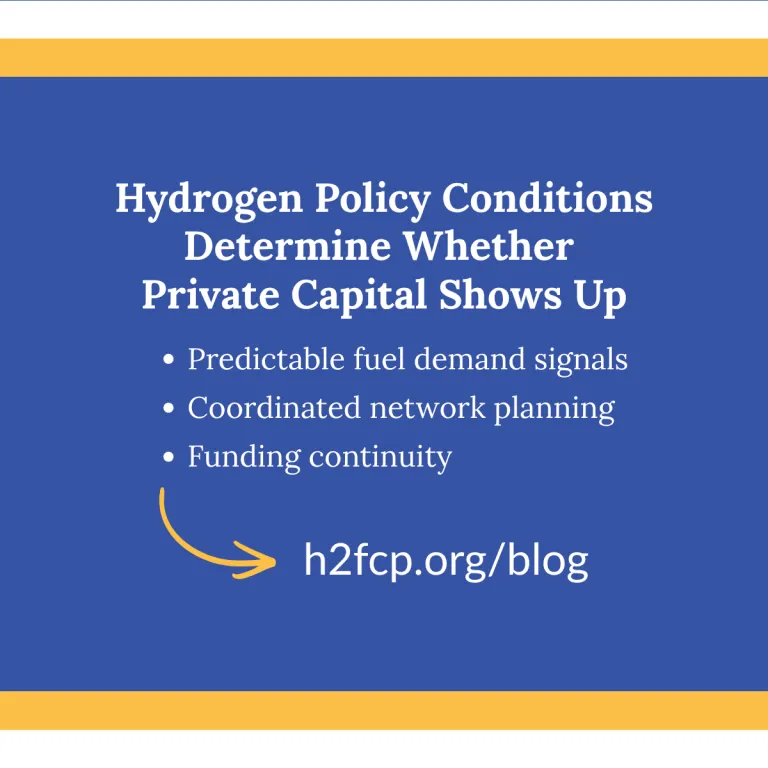
Policy conditions determine whether private capital shows up
Three market conditions do more than anything else to set the pace of hydrogen deployment:
- Predictable fuel demand signals. California's Low Carbon Fuel Standard (LCFS) has done more than any other program to drive renewable content into hydrogen transportation. Those are the types of levers that move station financing from possible to bankable. The California Air Resources Board’s amended LCFS raised the bar for renewable hydrogen content and improved the crediting treatment for refueling infrastructure. But policy predictability cuts both ways: when mandates are weakened or removed, demand can evaporate just as quickly; the loss of the heavy-duty vehicle mandate is a clear example of how quickly crushed demand signals can undercut a market that was starting to build. Those are the types of levers that move station financing from possible to bankable. Together, regulations and incentive programs give industry clear, predictable signals to react to and build a market around; take either away, and financing moves from bankable to speculative.
- Coordinated network planning. Stations and vehicles must arrive together; when they don't, both sides lose money and confidence. Coordinated planning among agencies, fuel providers, fleet operators, and vehicle manufacturers keeps them synchronized, and we're proud to lead the charge through collaboration, mobilization, and member engagement.
- Funding continuity. Private investors commit to the 20th station when there's a credible plan to develop enough stations to meet the needs of vehicles on the road. That principle held when California launched the world's first retail hydrogen market, and it holds now. None of that requires new invention: it just requires the coordination that launched the California hydrogen market before any other U.S. state built one.
Why this matters
Hydrogen production, distribution, and fueling create skilled, good-paying jobs. Zero-emission trucks moving through port communities and along freight corridors improve air quality in neighborhoods that have borne the brunt of diesel exhaust for generations. An expanded hydrogen energy system stores more clean energy that would otherwise be curtailed, creating a more resilient grid capable of deploying more renewable power.
Those benefits are worth building for, which means fixing the fuel supply, sequencing infrastructure with vehicles, and sustaining the market signals that bring private capital off the sidelines.