
California's 42 open retail hydrogen stations delivered 87% network availability in September 2026, Hydrogen Fuel Cell Partnership (H2FCP) staff reported at its recent quarterly webinar.
Ben Xiong, H2FCP's online communications director, and David Park, industry affairs director, covered the network, funding, and a new driver tool. Greg Todd of the California Hydrogen Car Owners Association (CHCOA) closed the session.
Reliability Is Climbing
Xiong said stations ran near 60% availability in 2024 and into 2025. By the end of 2025, after operators upgraded equipment and added on-site staff, availability reached 90%-95%.
“The operators have done a ton of their own work to improve the equipment, but also just having more staff, more personnel on site to fix these issues,” he said.
A February 2026 gaseous supply disruption took 21 stations offline. A secondary fuel supply has since returned 12 of them to service. Thirteen stations remain unavailable, nine of them because of the disruption. Iwatani's Riverside station is expected to open to all drivers at the end of October; SunLine Transit's Thousand Palms station is commissioning this year, and True Zero's Fremont station is expected in early 2027. Air Products closed its Diamond Bar and Torrance stations this year.
Since 2012, a little over 19,000 fuel cell electric vehicles have been sold or leased in the U.S., including 233 through August 2026.
SOSS Tool for Hydrogen Drivers
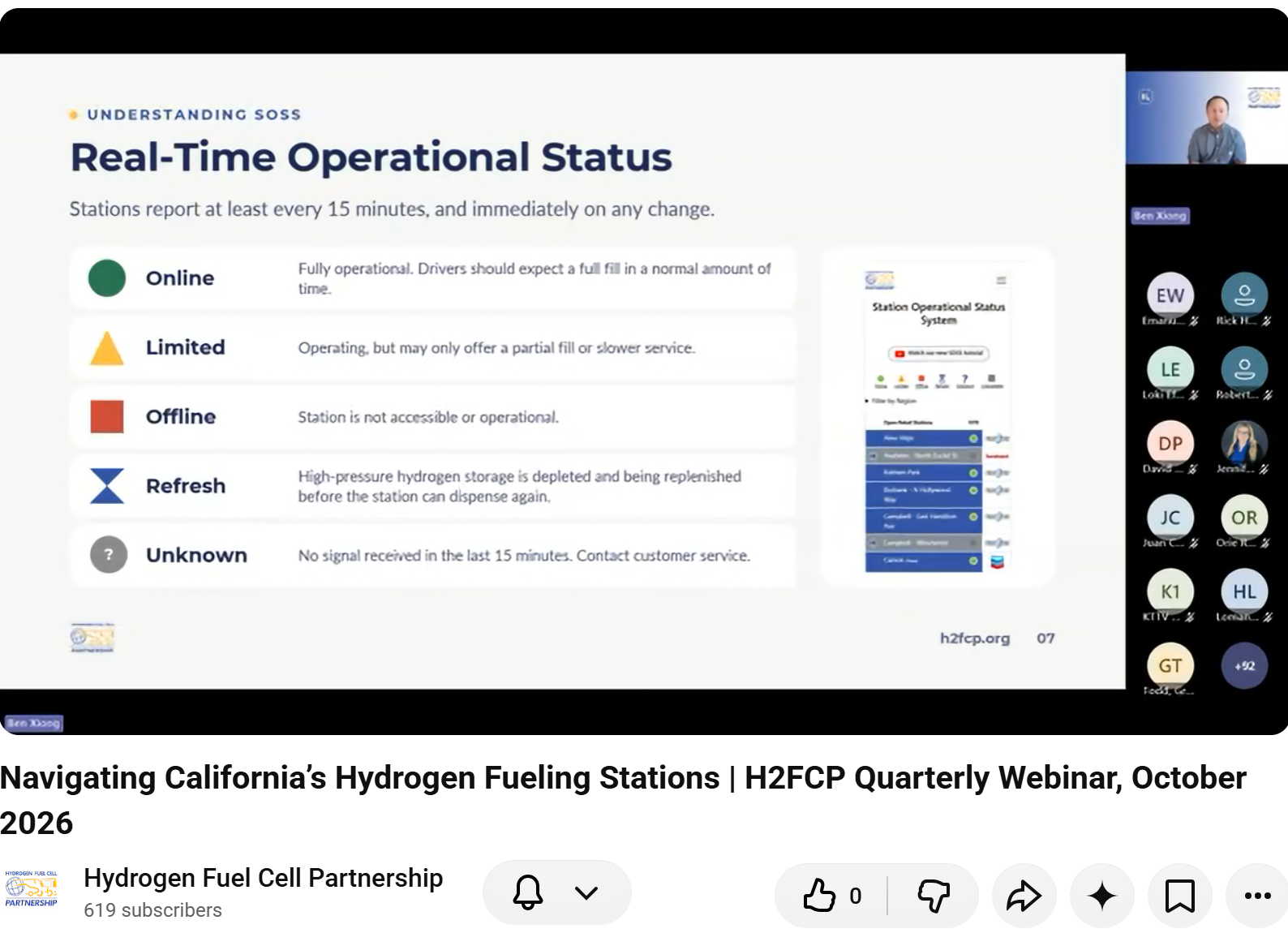
The partnership’s Station Operational Status System (SOSS) shows each open station's real-time status and updates at least every 15 minutes.
“I encourage you all to check the status of a station before you drive there,” Xiong said. A new Report Incorrect Status button lets logged-in drivers flag a mismatch and open a ticket with H2FCP and the station operator. CHCOA members get first access through the new Hydrogen Ambassador Program, ahead of a public rollout.
Funding
Under Assembly Bill 126, the California Energy Commission's (CEC) Clean Transportation Program must direct at least 15% of its funds each year to hydrogen fueling through 2030. The CEC is reviewing applications for two hydrogen solicitations worth $45 million and $4 million, with proposed awards expected before year-end.
Federally, the U.S. Department of Energy canceled the up to $1.2 billion planned for California's ARCHES hub in October 2025. Park said ARCHES will operate independently as a private marketplace integrator.
Price Comes Down to Volume
Park said prices at FirstElement Fuel's True Zero stations dropped from $36 to $25.99 per kilogram at liquid-supplied stations and from $36 to $29.99 at gaseous stations. He attributed the change to Toyota taking a management stake in FirstElement Fuel.
Looking ahead, “it's an issue of volume,” Park said. “We need to see more hydrogen volume going into and out of the marketplace and get to economies of scale.”
Heavy-duty trucks, which take 40 to 80 kilograms per fill compared with 1 to 5 for cars, can supply that volume, Park said. California developers building truck stations plan to add light-duty fueling islands “so those stations can service all manner of vehicles.”
Automakers have flagged Greater Sacramento, San Francisco, Los Angeles, Orange County and San Diego as priority regions for new stations.
Todd shared CHCOA's view of the market: “Our view is that hydrogen and battery are complementary. Many automakers build both, and together they can replace internal combustion.”
Todd also invited drivers to join (free!) at H2TONPS.org.
Reliable stations, steady supply, and new stations where drivers need them will grow the network. H2FCP brings automakers, station developers, energy providers, and agencies together to build that infrastructure. Learn more about H2FCP membership.