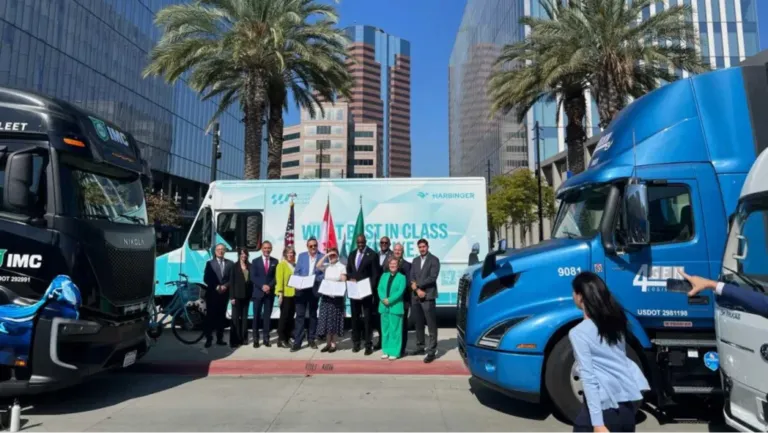
Five governments recently announced a coordinated plan to build hydrogen and electric fueling infrastructure along a major freight corridor stretching from Vancouver to Mexico.
The British Columbia to Baja California Zero-Emission Vehicle Corridor, or BC2BC, will support nearly 10,000 trucks traveling the I-5 corridor daily, with the initial phase including three hydrogen fueling stations and 20 electric charging stations.
For Hydrogen Fuel Cell Partnership (H2FCP) members and the broader hydrogen fuel cell industry, this announcement validates a strategy that has been advocated for over years: cross-jurisdictional coordination on infrastructure standards, long-haul truck support, and multi-state planning.
“This is what happens when the hydrogen industry stops working in silos,” said Bill Elrick, Executive Director of the Hydrogen Fuel Cell Partnership. “California proved the hydrogen fuel cell truck market works. Now we're seeing Oregon, Washington, British Columbia, and Baja California align around the same infrastructure and technical standards. That's a significant breakthrough.”
The three hydrogen fueling stations will give trucking fleets the route confidence they need to commit to fuel cell vehicles for regional and long-haul operations. Until now, a trucker purchasing a hydrogen truck faced real questions about fuel availability. BC2BC changes that equation.
The Port of Long Beach brought Southern California Edison, Tesla, EV Realty, and trucking operators to the announcement, demonstrating buy-in from utilities, Original Equipment Manufacturers (OEMs), and fleets.
For fleets running heavy-duty trucks on regional routes, hydrogen fuel cell vehicles do things battery-electric trucks still can't do at the same weight class. A fuel cell truck can go 300+ miles on a single tank, refuel in minutes, and carry a full payload. That capability (along with decarbonization and improved air quality) is what leads operators to choose hydrogen. BC2BC removes the last piece of the puzzle: the guarantee that they'll find fuel on the route.
Both technologies have a role in decarbonizing freight, and BC2BC's commitment to coordinate charging and fueling across jurisdictions removes a major barrier to adoption.
“Our members have been asking for this for years,” Elrick said. “They're ready to operate hydrogen fuel cell trucks at scale. What they needed was the infrastructure guarantee: the knowledge that they could move goods across state lines and refuel. BC2BC delivers that.”
The five participating governments committed to coordinating technical standards, infrastructure planning, and permitting requirements. That coordination work typically takes longer than the infrastructure itself. Getting California, Oregon, Washington, British Columbia, and Baja California to agree on standards means a truck that fuels in Long Beach can refuel in Portland, Seattle, and beyond without worrying about incompatible systems or gaps in availability.
The Port of Long Beach's role signals how central hydrogen and zero-emission trucks are becoming to freight decarbonization. The port aims to become North America's first zero-emission facility and plans to double cargo volume to 20 million containers by 2050. That doesn't happen without heavy-duty zero-emission trucks moving goods. BC2BC also feeds into the California-Baja California Border Master Plan, which will expand zero-emission vehicle and infrastructure planning across state and national boundaries.