|
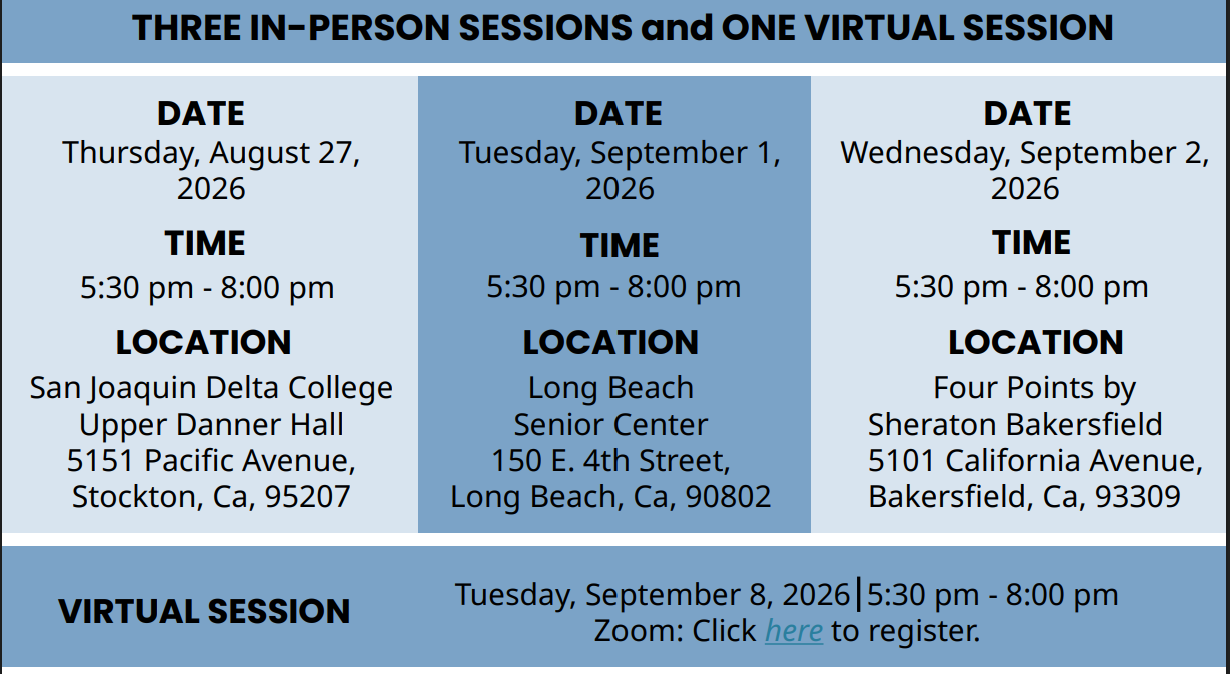
Registration is required for the virtual session only.
Once registered, you will receive a link to join.
California’s Air Resources Board (CARB), Department of Conservation (DOC), Natural Resources Agency (CNRA), Environmental Protection Agency (CalEPA), State Water Resources Control Board (SWRCB), and Office of State Fire Marshal (OFSM) invite you to attend community meetings to learn more and provide feedback about the State’s various efforts to advance the Carbon Capture, Removal, Utilization, and Storage Program, which was established by Senate Bill 905, (Caballero, Chapter 359, Statutes of 2022).
Carbon capture, removal, utilization, and storage involves the capture, transport, and long-term storage of carbon dioxide, usually in geological reservoirs that would otherwise be released to the atmosphere. It is an essential tool for California to address climate change by removing historical and ongoing emissions of carbon into the atmosphere and addressing sectors where emissions are unavoidable with no cost-effective or technologically feasible alternatives.
Each evening meeting will begin with an open house, where the public can look through various informational materials on the science behind carbon capture, removal, utilization, and storage while interacting with representatives from State agencies. The open house will be followed by brief presentations from each agency and multiple opportunities for agency leadership to listen to your comments, experiences, and recommendations. While feedback regarding any and all aspects of the entire multi-agency effort are welcome, we are specifically requesting feedback on CARB’s current rulemaking effort and CNRA’s proposed unitization framework.
Your input will help guide California's approach to carbon management.
Materials
An agenda, presentations, and other materials will be posted prior to the meetings on CARB’s Carbon Capture, Removal, Utilization, and Storage; Meetings Workshops, and Solicitations webpage.
You can access a copy of on CNRA’s webpage here: CNRA’s Draft Framework for Governing Agreements Pertaining to Carbon Sequestration.
The virtual meeting will be recorded and the recording will be posted on the Carbon Capture, Removal, Utilization, and Storage; Meetings & Workshops webpage.
Spanish language interpretation services will be provided at all four meetings.
Background
Governor Gavin Newsom signed into law Assembly Bill (AB) 1279 (Muratsuchi, Chapter 337, Statutes of 2022) and Senate Bill (SB) 905 (Caballero, Chapter 359, Statutes of 2022) to accelerate California’s climate action. These two pieces of legislation recognize the need to drastically reduce greenhouse gases (GHGs) to achieve carbon neutrality by mid-century and head off the worst impacts of climate change.
AB 1279 establishes the state’s goals to reduce GHGs by 85% below 1990 levels and achieve carbon neutrality no later than 2045. Further, the 2022 Scoping Plan Update prioritized transitioning away from the combustion of fossil fuels, backed up with the critical need for carbon capture, removal, utilization, and storage and carbon dioxide removal, as essential to achieving California’s ambitious climate goals.
SB 905 includes requirements of several State agencies. It requires CARB to identify and implement policies and strategies that enable the removal of carbon dioxide (CO2) from the atmosphere through carbon capture, utilization, and storage technologies. CARB hosted a virtual workshop on June 23, 2026, where staff presented the anticipated regulatory timeline, an overview of the Concepts for Potential Regulations for Establishing the Carbon Capture, Removals, Utilization, and Storage Program (Concepts), which was released for public review on May 7, 2026, and summarized feedback received from the public on the Concepts.
SB 905 also requires CARB to create the Carbon Capture, Removal, Utilization, and Storage Program to evaluate the efficacy, safety, and viability of carbon capture, removal, utilization, and storage and carbon dioxide removal projects and technologies, to ensure that carbon capture, removal, utilization, and storage and carbon dioxide removal projects meet certain monitoring, reporting, and financial responsibility requirements, and to provide other specified program elements. A draft of the Environmental Impact Analysis (EIA) will be released for public review and comment when the staff report is released.
SB 905 requires CNRA, in consultation with the California Public Utilities Commission, to "provide a proposal to the Legislature to establish a state framework and standards for the design, operation, siting, and maintenance of intrastate pipelines carrying carbon dioxide fluids of varying composition and phase to minimize the risk posed to public and environmental health and safety,” (Public Resources Code 71465 (b)).
The Office of the State Fire Marshal, Pipeline Safety Division, regulates the design, construction, testing, operation, maintenance, emergency planning, and integrity management of intrastate carbon dioxide pipelines in California under the California Pipeline Safety Act. Senate Bill 614 requires OSFM to adopt regulations governing the safe transportation of carbon dioxide in pipelines that are, at a minimum, as protective as the draft federal regulations set forth in the unofficial version of the Notice of Proposed Rulemaking issued by the Pipeline and Hazardous Materials Safety Administration.The OSFM has since adopted emergency regulations, which became effective July 1, 2026.
Contact
If you have any questions regarding the listening sessions, please contact ccs@arb.ca.gov.
Subscribe
You may be receiving this message because you are subscribed to a related topic. To ensure you stay up-to-date on all future communications related to development of CARB’s Carbon Capture, Removal, Utilization, and Storage Program, please subscribe.
Real and Increasing Costs of Climate Change Impacts for Californians
The science behind climate change is irrefutable. With the increasing severity and frequency of drought, wildfire, extreme heat, and other impacts, Californians just have to look out their windows to know that climate change is real and rapidly worsening. The impacts once thought decades away are happening now. Recent reports detail some of the impacts to the state:
- A 2024 national report ranked California the worst state for natural disasters fueled by a changing climate, with expected annual losses totaling more than $16 billion statewide.
- Home insurance is harder and more expensive to get. Seven of California’s largest property insurers, State Farm, Allstate, Farmers, USAA, Travelers, Nationwide and Chubb recently limited new homeowners policies in the Golden State — raising questions about the stability of the California home insurance market.
- During an 11-year period, exposure to wildfire smoke caused more than 50,000 deaths in California and more than $400 billion in economic impacts.
- During seven extreme heat events over the past decade, California experienced $7.7 billion in losses.
- Fueled by record drought conditions linked to climate change, the January 2025 Southern California wildfires caused widespread losses including at least 440 deaths, with 31 direct deaths and 409 indirect fatalities from smoke or healthcare disruptions, and destruction of over 16,000 structures. The economic impacts from these fires alone is estimated to be more than $30 billion.
|