The US zero-emission ferry sector is entering a pivotal phase, driven by tighter emissions regulations, increasing public investment, and a growing pipeline of commercial projects.
The Federal Transit Administration (FTA) has allocated USD 98 million through its FY2026 Electric or Low-Emitting Ferry Pilot Program, which provides competitive funding for the purchase of electric or low-emission ferries and the electrification or emissions reduction of existing vessels.
The West Coast is leading the deployment of zero-emission ferries. California's Commercial Harbor Craft Regulation, which requires short-run ferries to be fully zero-emission and mandates an 89 percent reduction in diesel soot across the broader harbor craft fleet by 2035, is compelling operators along the coast to act. Further, in San Francisco Bay, the hydrogen fuel cell-powered M/V Sea Change has completed passenger service demonstrations before entering public service, providing valuable operational experience with hydrogen propulsion. Meanwhile, San Francisco Bay Ferry, through its Rapid Electric Emission-Free (REEF) Ferry Program, has approved the procurement of three battery-electric high-speed passenger ferries under a USD 46 million contract, with the first vessel expected to enter service in early 2027. Further south, construction is under way on two all-electric ferries for the San Diego–Coronado route, with the first vessel expected to be delivered in late 2026.
Beyond California, Washington State Ferries (WSF) is advancing its Ferry System Electrification Program, which aims to introduce up to 16 new hybrid-electric vessels as part of its goal of achieving an emission-free ferry fleet by 2050. The first vessel under the program, M/V Wenatchee, returned to service in mid-2025 following its conversion to hybrid-electric propulsion.
On the East Coast, New York introduced the Clean Ferries Bill in May 2026, which, if enacted, would require publicly funded ferry operators to procure only zero-emission vessels beginning in 2028.
While these developments demonstrate growing progress, the transition remains complex. Operators must evaluate vessel technologies, including battery-electric and hydrogen propulsion, develop viable financing strategies, and invest in charging, fueling, and shoreside infrastructure. Delivering these projects will also require close coordination among ferry operators, port authorities, utilities, shipyards, technology providers, and government agencies.
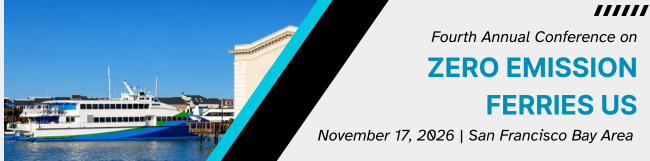
Against this backdrop, Global Mass Transit is organizing the fourth annual Zero Emission Ferries Conference on November 17, 2026, in the San Francisco Bay Area, bringing together ferry operators, public agencies, shipbuilders, technology providers, and industry stakeholders to discuss practical strategies, emerging technologies and lessons from projects that are shaping the next phase of ferry decarbonization in the United States.
Mission
The mission of the conference is to discuss the deployment of zero emission ferries in the US, funding available, strategies, case studies, best practices, recent developments, key challenges, plans and future outlook. It will also provide information on procuring, financing, operating, and maintaining zero-emission ferries and infrastructure. The conference will also highlight opportunities and technological innovations.
Key topics to be discussed
-
Transitioning to zero emission ferries: strategies and best practices
-
Partnership between stakeholders in industry, financiers and government
-
Scaling deployment: lessons learned from early projects
-
Project pipeline, financing and procurement strategies
-
Choosing between different low/zero emission options: hydrogen, electric, hybrid, etc.
-
Hydrogen fuel cell ferries: commercial deployment, lessons learned and future opportunities
-
Battery-powered electric ferries: scaling deployment and operational experience
-
Challenges for operators (Operational readiness, maintenance, charging logistics, crew training, fleet scheduling etc)
-
Economics of zero emission ferries
-
Funding mechanisms, policies and investment models
-
Port and terminal electrification
-
Designing, building and delivering next-generation zero-emission ferries: insights from shipbuilders and OEMs
-
Charging options, deployment of charging infrastructure, challenges and opportunities
-
Partnerships with utilities/energy suppliers, impact on the grid
-
Commercial readiness and adoption of zero-emission marine technologies
-
Worker training to support electrification technology