
The hydrogen truck market just got a real-world stress test, and it held up.
That was the throughline of our July 30 webinar on the Guiding Principles for Hydrogen Truck Market Development, where David Park, Industry Affairs Director at the Hydrogen Fuel Cell Partnership (H2FCP), and James Kast, General Manager of Iwatani Corporation of America and a member of our board of directors, walked members through the findings behind our recently published white paper.
WATCH:
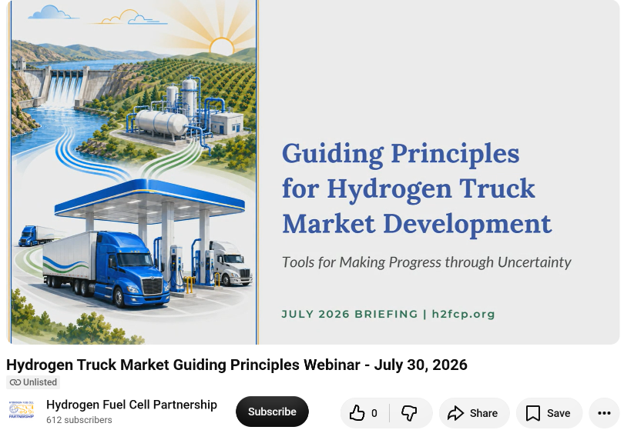
The paper started with a modeling exercise back in 2023 and 2024, before California's Advanced Clean Fleets pause, before Congress revoked CARB's authority to enforce the Advanced Clean Trucks rule, before billions in federal hydrogen hub funding were pulled back. Then 2025 happened. Kast said the shift gave the panel's original modeling an unplanned but useful test.
“This type of shock didn't actually change our findings,” Kast said. “It validated what we were looking at, even though the world looked very different.”
Cost is the issue everything else runs through
The panel started with 34 factors across eight categories and narrowed them to five core issues. One sits above the rest.
“Almost everything impacts price at the end of the day,” Kast said. “What your policy does impacts how many stations you build, impacts how low your cost can be, and what incentives you have.”
Fleets need hydrogen at $5 to $12 per kilogram to compete with diesel, depending on duty cycle and total cost of ownership assumptions. Transit agencies with long-term offtake contracts have held prices near $10 per kilogram. Retail light-duty stations, by contrast, have swung from $13 to $36 per kilogram, reflecting fragmented, unpredictable demand.
Drayage as the strategic starting point
Kast walked through how drayage, especially at ports, aligns with almost every factor that drives costs down: concentrated fleets, predictable routes, and proximity to some of the state's most severe air quality non-attainment zones.
The Port of Long Beach's fuel subsidy program, funded through existing container fees, was his example of what fast, practical progress looks like.
“They very quickly recognized that TCO and the cost of fuel was the main driver,” Kast said. “Instead of waiting for a solution, they jumped in.”
Two tracks, not one
The webinar reinforced what the white paper argues: hydrogen's path forward relies on compliance-driven and economics-driven strategies simultaneously, not one or the other.
“This is not,'let's only focus on economics or only focus on compliance,'” said Kast. “We have to look at them both together in parallel.”
He pointed to Hyundai's Georgia project and Toyota's HyRoad partnership as fleet- and OEM-led investments that are moving forward without relying on public subsidies, and to the Gulf Coast, where low-cost hydrogen supply and existing pipeline infrastructure offer a different kind of on-ramp, one built on regional economics rather than state mandates.
Hydrogen and battery-electric, doing different jobs
Kast was direct about where fuel cell and battery-electric trucks each fit. Battery-electric works well for return-to-base routes when schedules align with charging windows. Fuel cell trucks make more sense for multi-shift, high-utilization routes where fast refueling and payload matter more than anything else.
“We're definitely not saying fuel cell is going to do everything in the truck market,” Kast said. “We're going to need both. They're both very important, and at times they can actually support each other.”
The bottom line
Park framed the panel's conclusion simply: “We do need policy, and we need economics to work hand in glove.”
Kast's closing point was built on that. “Economics themselves, supported by sound policy. Mandates or not, you can still make good progress.”
GO DEEPER: Read the full Guiding Principles for Hydrogen Truck Market Development for the complete five-issue framework and strategic recommendations.
The hydrogen truck market doesn't need to wait on a single lever. Fleet by fleet, corridor by corridor, the work of building it is already underway. Learn more about membership at h2fcp.org/join-us.