The Hydrogen Fuel Cell Partnership (H2FCP) doesn't represent drivers, yet they are the reason we do everything we do. Our members are the vehicle manufacturers, station operators, fuel suppliers, transit agencies, and state agencies who build the hydrogen market for the benefit of these drivers, and everyone wants clean air and a stronger economy.
Drivers are the reason that work exists, and they're the proof that it works. With National Hydrogen and Fuel Cell Day on October 8, this month's post is dedicated to them.
Why drivers choose hydrogen
The reasons are practical. According to the U.S. Department of Energy's Alternative Fuels Data Center, drivers of light-duty fuel cell electric vehicles can fill up in less than five minutes and get more than 300 miles of range, with zero tailpipe emissions.
The car drives like any electric vehicle: quiet, smooth, and responsive. The difference is where the electricity comes from. A fuel cell makes it in real time from hydrogen stored on board and oxygen from the air; the only thing that comes out of the tailpipe is water. (See also: Hydrogen Myths & Facts.)
The vehicles on the road today back that up:
- Toyota's 2026 Mirai has an EPA-estimated range of 402 miles, and Toyota pairs it with up to $15,000 in complimentary hydrogen (six years for purchases, three for leases), an eight-year/100,000-mile warranty on fuel cell components, and 21 days of complimentary rental car use during the first three years.
- Honda's CR-V e:FCEV, America's first production plug-in hydrogen fuel cell vehicle, combines a U.S.-made fuel cell module with plug-in charging for around-town electric driving and hydrogen for longer trips. It has a 270-mile EPA-estimated range, comes with a fuel card worth up to $15,000 over a three-year lease, and eliminates the need for oil changes entirely.
- Hyundai's NEXO, the fuel cell SUV available in California since 2018, has been fully redesigned. The second-generation model refuels in about five minutes and delivers up to 826 km (about 513 miles) of range on Europe's WLTP test cycle. Hyundai hasn't yet announced a U.S. launch date.
And drivers explain their choice better than the specs ever could:
“Every time I look at my hydrogen fuel cell car, I’m struck by what a technological wonder it is. The driving experience is equivalent to or better than that of your standard gas-powered car, and it only takes me 3 minutes to fill up, compared to the 8 hours it takes for my wife’s battery-powered EV. I wish more people could experience these cars. It’s exciting to be a part of the future of clean energy transportation.” -John Michael Parkan
“I have a first-gen Mirai, and I've loved it from the beginning. It has Lexus-like features and acceleration similar to a battery electric vehicle. My next move will be the second-gen Mirai, but I haven't gotten around to it yet; I'm still enjoying my first Gen. As gas prices keep going up, the case for this car gets more and more compelling.” -Greg Todd
“I have worked in this industry since 2006 and driven the early generations of FCEVs. When the time came when the public could lease or purchase, it was such an exciting time! Having a choice of a zero-emission vehicle, and one that replaces a vehicle in our family, is ideal. I can fuel much like I did with gasoline and be on my way. The vehicles are amazing: quiet, great performance, and with all of the comforts.” -Jennifer Hamilton
A hard spring, and a hydrogen network that kept rebuilding
With fuel supply disruptions hitting the network in early 2026, every hydrogen mile driven in California this year has been earned.
Drivers patiently planned around it. They checked our Station Operational Status System (SOSS) and generated real-time reports to help the driver behind them make informed decisions. They waited in line and kept fueling.
As of today, 42 hydrogen stations are open and operational in California, with the remaining stations affected by the gaseous hydrogen supply disruption expected to reopen in the near future.
And we'll cover the full current picture on our October 7 webinar.
Here's the context the outage headlines missed: before February, station reliability in California had been climbing for two years. The California Air Resources Board’s (CARB) 2025 Annual Evaluation reported average network availability improving from 58 percent in Q2 2024 to 74 percent in Q2 2025. Our own SOSS data showed monthly availability above 90 percent by the end of 2025.
That improvement came from station operators investing in upgraded equipment, added staffing, and backup systems. It's the same operator community that spent this spring bringing stations back online for drivers.
The build-out didn't stop either:
- Chevron opened its third California hydrogen station in Carson in February 2026, following Moreno Valley and Vacaville, bringing the state's listed retail network to 52 open stations.
- Our tracker counts 106 retail hydrogen stations in development in California, plus four heavy-duty truck stations in operation and nine more funded.
- In August, the California Energy Commission (CEC) approved a $95.2 million investment plan for fiscal year 2026-27, with $15 million going directly to hydrogen refueling. And in September, California, Oregon, Washington, British Columbia, and Baja California committed to the BC2BC Zero-Emission Vehicle Corridor, with an initial phase that includes three hydrogen fueling stations along I-5.
Momentum through infrastructure is built one station and regional corridor at a time. And the roughly 14,000 registered fuel cell vehicles in California, part of the 19,055 fuel cell cars sold and leased nationwide to date, are the drivers who make every one of those stations worth building.
2026 National Hydrogen Day
On Wednesday, October 7, we will host the State of the Hydrogen Network webinar, a candid look at where California's refueling network stands today, what the disruption has taught the industry about supply resilience, and what's coming next. Registration is open now, and drivers, members, agency staff, and anyone considering a fuel cell vehicle are welcome.
The following day is National Hydrogen and Fuel Cell Day, established by the Fuel Cell and Hydrogen Energy Association in 2015 and set on October 8th to reflect hydrogen's atomic weight of 1.008. Congress has recognized it with bipartisan resolutions in both chambers, most recently for 2025.
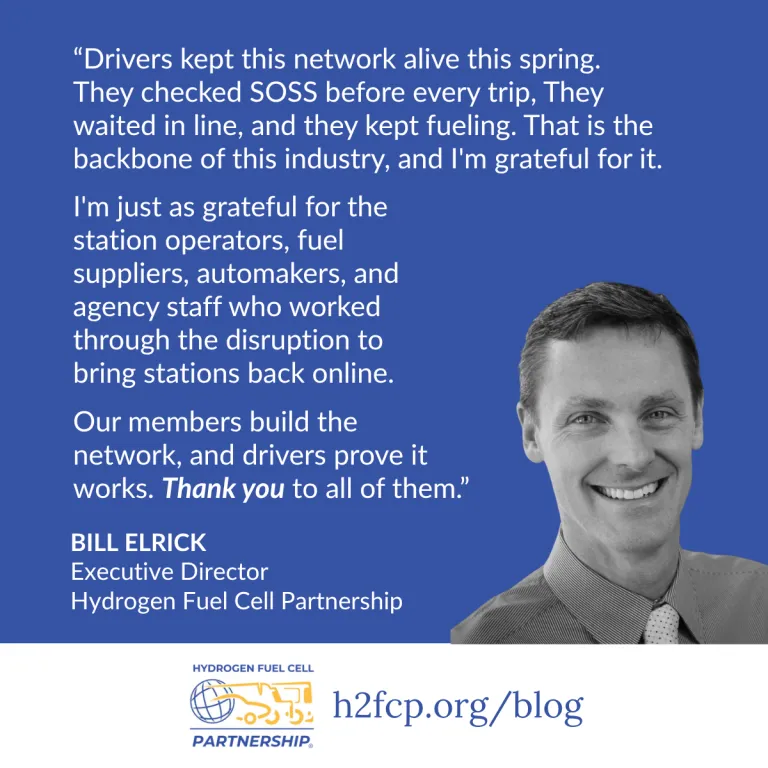
“Drivers kept this network alive this spring,” said Bill Elrick, Executive Director of H2FCP. “They checked SOSS before every trip, they waited in line, and they kept fueling. That is the backbone of this industry, and I'm grateful for it. I'm just as grateful for the station operators, fuel suppliers, automakers, and agency staff who worked through the disruption to bring stations back online. Our members build the network, and drivers prove it works. Thank you to all of them.”
How H2FCP supports hydrogen drivers, and what members make possible
Beyond industry leadership and education, our primary contribution to drivers is one tool: SOSS, our real-time station status system that drivers check before heading to a station and that operators use to report outages.
State agencies and Low Carbon Fuel Standard reporting participants rely on it as well, as do third-party map apps that pull SOSS data into their own platforms. We’re now in the process of further upgrades and modernizations to make the tool even faster and more dependable.
Everything else drivers depend on, from the dispenser to the delivery truck to the codes and standards that make a fill safe, is built by our members.
Founded in California in 1999, we convene vehicle manufacturers, station developers, fuel producers, transit agencies, and policymakers to build the hydrogen market together. Members get direct access to the officials setting hydrogen policy, real-time SOSS station data for their own applications, representation on codes and standards committees, and seats on the working groups solving market development problems every day. Three membership levels, Executive Champion, Champion, and Associate, provide organizations of every size a way in.
The drivers have done their part this year. The network needs to grow, and growing it takes all of us. Learn more about membership at h2fcp.org/join-us.
Driver resources
- Station Operational Status System (SOSS)
- Want to serve as a hydrogen ambassador? Learn more at h2tonps.org/whats-new-1.
- Governor Newsom announces $3,500 instant rebates now available for Californians buying their first zero-emission vehicle (August 2026)
- Facebook Driver Groups
- Hydrogen Fuel Cells - Clean Energy Production For Homes And Transport Facebook Group
- Hydrogen is the answer Facebook Group
- Hydrogen BMX Racing - Owners and Fans Facebook Group
- LinkedIn Groups